This section draws on two source decks: AIA_Training_Structured Thinking_v1.pptx (AIA's internal 'Consulting 101' training on hypothesis-based problem solving and communication) and AIA_Methodologies_2024.pptx (StratXe, Project Based Action Learning and AIA's own knowledge-governance model). Both are cited slide-by-slide below.
AIA's Structured Thinking Method
Source: AIA_Training_Structured Thinking_v1.pptx — AIA's internal training deck on hypothesis-based problem solving (‘Consulting 101’), covering how AIA consultants think through a problem and then argue their answer.
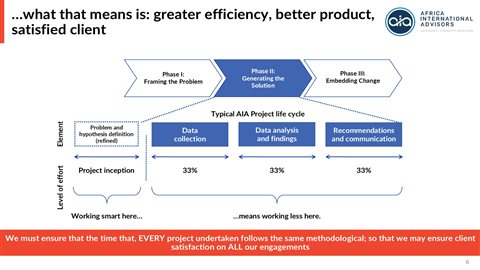
The typical AIA project life cycle: Phase I, II, III
AIA frames every engagement as a three-phase life cycle — Phase I: Framing the Problem (project inception, refining the problem and hypothesis definition), Phase II: Generating the Solution (data collection, then data analysis and findings), and Phase III: Embedding Change (recommendations and communication) — with effort split roughly evenly across data collection, analysis and recommendations once inception is complete. The underlying discipline is 'Think, Write, Edit' rather than 'Think, Write, Re-Write, Re-Write, Re-Write…': getting the structure right early is what keeps the team from repeatedly rewriting under deadline pressure. As the deck puts it: 'a problem well defined is a problem half solved.'
Typical AIA project life cycle: Phase I (Framing the Problem) → Phase II (Generating the Solution) → Phase III (Embedding Change)
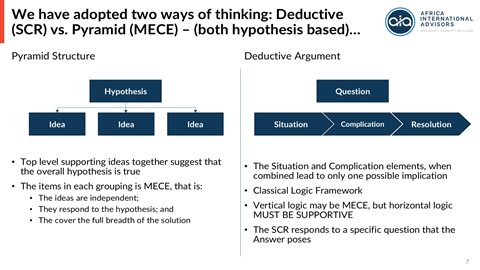
Two hypothesis-based thinking modes: SCR and the Pyramid (MECE)
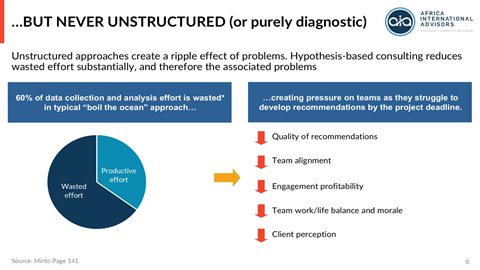
AIA consultants reason in two complementary, hypothesis-based modes. The Deductive Argument (Situation → Complication → Resolution, or 'SCR') is a classical logic framework: the Situation and Complication, combined, lead to only one possible Resolution, and the SCR must respond to a specific question the Answer poses. The Pyramid Structure puts the Hypothesis at the top, supported by Ideas below it, where every grouping of ideas must be MECE — Mutually Exclusive, Collectively Exhaustive: the ideas are independent, they respond to the hypothesis, and together they cover the full breadth of the solution. AIA is explicit that vertical logic may be MECE, but horizontal logic must be supportive. The alternative — an unstructured, 'boil the ocean' approach — is costly: AIA's own benchmark (citing Minto) is that 60% of data collection and analysis effort is wasted in unstructured engagements, which in turn erodes the quality of recommendations, team alignment, engagement profitability, work/life balance and client perception.
Deductive Argument (Situation → Complication → Resolution) vs. Pyramid Structure (Hypothesis → MECE ideas)Why never unstructured: 60% of data collection and analysis effort is wasted in a typical 'boil the ocean' approach (Source: Minto, p.141)
Generating and validating hypotheses: issue trees, brainstorming, top-down / bottom-up
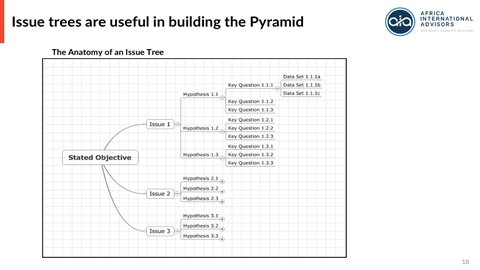
AIA names three components of effective hypothesis generation: brainstorming an initial SCR (with advance preparation, no bad ideas, no stupid questions, capturing everything, and not getting bogged down), building a Pyramid Structure that is MECE, and developing storyboards. Hypotheses are then validated by holding two perspectives at once: hypothesis generation is a top-down process, while data collection and analysis is primarily bottom-up — maintaining both keeps recommendations fact-based and insightful. The working tool for this is the issue tree: a Stated Objective is broken into Issues, then Hypotheses, then Key Questions, then the Data Sets needed to answer them. Once built, the team reality-checks the tree by reading right to left: does the data answer the key question? Does the key question address the hypothesis? Does the hypothesis solve the issue? A completed issue tree converts directly into a storyboard — preferably via SCR — which becomes the client presentation.
The anatomy of an issue tree: Stated Objective → Issues → Hypotheses → Key Questions → Data Sets
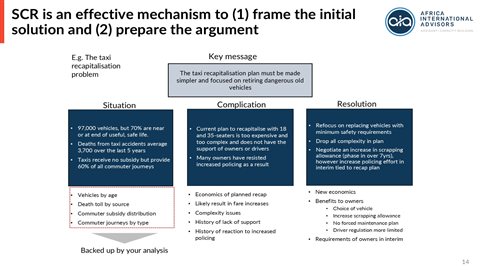
The deck's own worked example shows SCR used to both frame a solution and prepare the argument. Situation: minibus taxis provide 60% of commuter journeys and receive no subsidy, yet of roughly 97,000 vehicles, 70% are near or at the end of their safe working life, and taxi accidents cause an average of 3,700 deaths a year. Complication: the current recapitalisation plan (18- and 35-seater vehicles) is too expensive and too complex, lacks the support of owners or drivers, and owners have resisted the increased policing that came with it. Resolution / key message: the plan must be simplified and refocused on retiring dangerous old vehicles — drop the added complexity, negotiate an increased scrapping allowance phased in over seven years, tie increased policing effort to the recap plan rather than imposing it separately, and drop the forced maintenance plan. The Situation and Complication, combined, point to only one credible Resolution — exactly the deductive-logic test the method is built on.
Worked SCR example: the taxi recapitalisation problem — Situation, Complication and Resolution, each backed by analysis
Building the argument top-down: Answer First and storyboard formats
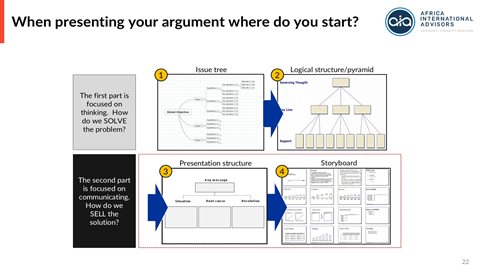
When presenting an argument, AIA's rule is to always build logic from the top down — the answer first. The full path runs from issue tree, to logical structure / pyramid, to storyboard, to presentation structure: the first half of the process is about solving the problem (thinking), the second half is about selling the solution (communicating). A storyboard can legitimately be developed in several different ways depending on the stage and the medium at hand — a logic tree sketched on paper, a rolling pack built directly in PowerPoint, or a written 'strap-line summary' in Word — provided the underlying hierarchy (governing thought, key line, supporting detail) carries through into the final presentation structure.
From thinking to communicating: issue tree → logical structure/pyramid → storyboard → presentation structure
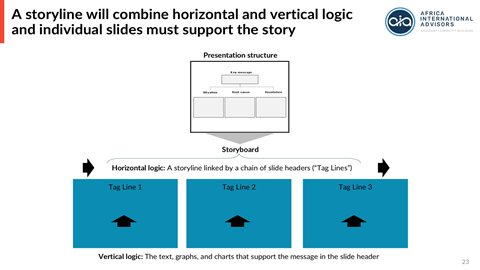
A storyline combines two axes of logic: horizontal logic, a storyline linked by a chain of slide headers ('Tag Lines'), and vertical logic, the text, graphs and charts on each slide that support that slide's own message. Each Tag Line should carry exactly one explicit message, phrased as a finding rather than a topic — right: 'The beer market is growing 22% per annum'; wrong: 'The size of the beer market'. The Body should support and build on the Tag Line only: one slide, one message, with no 'continued' slides, because splitting a message across two slides blurs the logic. The Kicker — not required on every slide — answers the 'so what?': the takeaway the Tag Line and Body were building toward.
Horizontal logic (Tag Lines chaining the storyline) and vertical logic (the detail supporting each Tag Line)
The training closes with a live exercise rather than more theory: two groups are each given 'How do we solve the present dilemma around land in South Africa?' as the question, and asked to build a competing argument — one for, one against expropriation of land without compensation (with alternatives proposed) — and to structure it into an 8-slide presentation with a clear recommendation. It is a direct, practical test of the full method above: frame the problem, build the SCR and pyramid, develop the storyboard, and present the answer first.
Source: AIA_Methodologies_2024.pptx — how AIA packages this thinking into a delivery model (StratXe, Project Based Action Learning) and governs its own intellectual capital.
Structured Thinking as an AIA delivery input
AIA's methodology pack names 'Structured Thinking' directly as one of three inputs — alongside a repository of best practices and targeted ecosystem integration — that AIA's consulting partners bring to StratXe, its specialised, AI-integrated strategy and execution platform. The method detailed in the section above (SCR, the Pyramid, MECE, issue trees, storyboarding) is what that reference in the methodology pack was pointing to.
Source: AIA_Methodologies_2024.pptx (slides 23)
Why strategy execution fails without structure
AIA's own diagnosis of why strategy execution fails is explicit and evidence-based: misaligned leadership, poorly defined strategy, poor definition and prioritisation of initiatives, information and governance asymmetries, limited performance management, and limited agility and adaptability. AIA's central argument is that quality decisions require quality information, and that closing the information gap between decision-makers and delivery teams is what separates good strategy from good execution.
AIA's delivery model embeds client staff as secondees within the AIA project team so that skills transfer happens on the job, not in a classroom after the fact. This is independently evidenced at scale on the AIA website: Project Khaedu, one of the largest public-sector management training programmes in South Africa, trained over 5,000 government managers using Action Learning methodology.
Source: AIA_Methodologies_2024.pptx (slides 25)
How AIA governs its own intellectual capital
The methodology pack this Academy is built from is itself governed by a simple, explicit model: Corporate Support is the Custodian, the Proposal Developer / Bid Office is the Admin, and Practice Leads and Consultants are the Contributors. The pack is described as a 'live working deck', explicitly meant to grow through collaboration — the same governance model this Knowledge Hub inherits (see Governance).
Source: AIA_Methodologies_2024.pptx (slides 3)
A structured approach to change, not just strategy
Where AIA shows a genuinely structured, repeatable sequence for a complex change problem, it is in Change & Culture Management: Prepare for Change (build awareness and desire), Manage Change (communicate and build capacity) and Reinforce Change (develop mechanisms to sustain change) — paired with a five-stage Define-Assess-Decide-Implement-Reinforce culture transformation process.