PPP Centre of Excellence Design & Infrastructure Financing Structuring
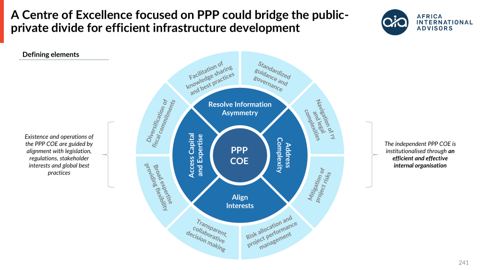
AIA's approach to designing a Public-Private Partnership Centre of Excellence, addressing information asymmetry, interest alignment, complexity and access to capital, and structuring the contractual and financing relationships (e.g. DBFOM) between public and private partners.
What it is
A methodology for designing a PPP Centre of Excellence (or similar infrastructure-financing institution): a four-step approach covering project contextualisation (macro-analysis, problem statement, hypothesis for the entity's mandate), infrastructure value-chain mapping, best-practice benchmarking and gap analysis, and analysis of legal form, financing and governance/accountability options — illustrated with standard project-finance structures such as Design-Build-Finance-Operate-Maintain (DBFOM) contracts.
Problem it solves
Infrastructure delivery through PPPs is often blocked by information asymmetry, misaligned interests, regulatory/legal complexity and constrained access to capital and expertise; a dedicated institutional vehicle, correctly designed, can resolve these systematically.
When to use
- A government or development-finance client is considering establishing a dedicated PPP or infrastructure-financing institution
Key questions
- What problem would the new entity's mandate solve?
- What does the current infrastructure value chain look like, and where are the gaps versus best practice?
- What legal form, financing structure and governance/accountability model should the entity take?
Inputs
- Infrastructure policy and macro-context analysis
- Value-chain mapping of existing infrastructure delivery participants
- Comparative benchmarking of similar institutions (e.g. World Bank PPP guidance, DPSA requirements)
Steps
- 1Project contextualisationConduct infrastructure macro-analysis and policy review; identify complexity and challenges; define the problem statement; test a hypothesis for the entity's mandate and functions.
- 2Map the infrastructure value chainMap the as-is value chain, all participants, their legislative mandates and hand-overs; identify overlaps, risks and opportunities.
- 3Benchmark and gap-analyseReview best practice (e.g. World Bank PIM, DPSA guidance) and benchmark comparable institutions; compare gaps against the proposed mandate.
- 4Determine legal form and financingAnalyse available legal forms, financing options and governance/accountability options for the entity.
Outputs
- Defined entity mandate and functions
- Legal form and financing structure recommendation
- Governance and accountability model
Source visuals