Agile Organisation Design (Value Stream Methodology)
AIA's methodology for designing agile organisations around customer outcome value streams: mapping Jobs To Be Done (JTBD) into value streams, validating designs with delivery teams through structured workshops, then building team constructs (L3/L4 design) and sizing.
What it is
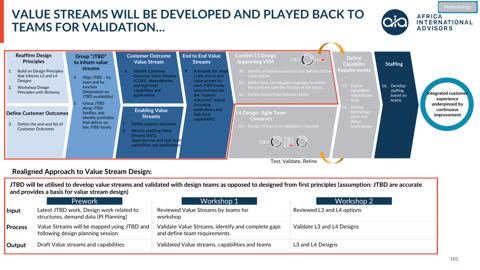
A staged value-stream design method: define customer outcomes and group Jobs To Be Done (JTBD) into value-stream families; map the end-to-end value stream for each family (Customer Outcome Value Streams and Enabling Value Streams); validate with delivery teams in workshops; then design team constructs (L3 design) and detailed team composition (L4 design), staffing and sizing.
Problem it solves
Restructuring around 'agile teams' without first mapping value streams to real customer outcomes produces teams that don't map cleanly to delivery, causing duplication and hand-off friction.
When to use
- A large customer-facing organisation is redesigning around value streams / agile teams rather than traditional functional structure
When not to use
- The organisation has not yet completed JTBD or customer-outcome definition work — value streams cannot be reliably mapped without it
Key questions
- What are the end-to-end customer outcome value streams?
- What enabling value streams and capabilities support them?
- What team constructs (L3/L4) are required, and how should they be staffed and sized?
Inputs
- Jobs To Be Done (JTBD) inventory
- Current organisational structure and demand data (e.g. PI planning)
- Design principles agreed with the business
Steps
- 1Define customer outcomes and value streamsGroup JTBD by family and identify the portfolios that deliver each JTBD family.
- 2Map end-to-end value streamsArticulate the steps in each Customer Outcome Value Stream and Enabling Value Stream, including dependencies, capabilities and applications.
- 3Validate with teamsPlay back draft value streams to delivery teams in structured workshops to identify and close gaps.
- 4Design team constructs (L3)Define team mandates, missions and interactions based on validated value streams.
- 5Design detailed teams (L4)Define capabilities required per team, review technology-stack implications, and develop staffing and sizing.
Outputs
- Validated value stream maps
- L3 team construct design
- L4 detailed team design with sizing
- Design Authority submission pack
Source visuals