Digital Transformation / ICT Strategy
AIA's digital-transformation and ICT-strategy methodology, spanning market-trend situational analysis, an AS-IS/TO-BE architecture roadmap, ICT capability maturity assessment, and a strategic-initiatives prioritisation framework.
What it is
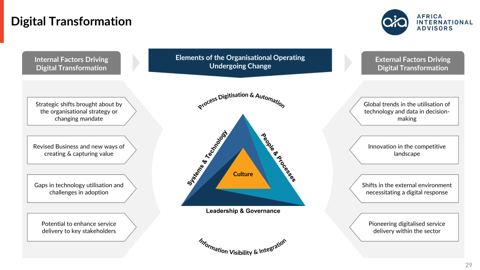
An end-to-end digital transformation methodology combining: (1) a situational analysis of internal and external digital trends across Culture, Systems & Technology, People & Processes, and Leadership & Governance; (2) a Target Operating Model-style AS-IS/TO-BE architecture roadmap; (3) an ICT Operating / capability maturity assessment across up to seven ICT domains (Business Partnering & Innovation, Technology Strategy & Architecture, Tech Talent, Service Delivery, Service Integration & Orchestration, Protect, Data & Analytics) rated on a five-level maturity scale; and (4) a Strategic Initiatives Prioritisation Framework scoring initiatives on Business Value, Feasibility and Execution Certainty.
Problem it solves
Digital transformation programmes fail when they jump to technology solutions without first understanding internal/external drivers, current ICT maturity, and a defensible way to prioritise competing digital initiatives.
When to use
- A client needs a digital transformation strategy, IT/ICT strategy, or e-business strategy
- An organisation needs to prioritise a portfolio of competing digital initiatives
When not to use
- The engagement is narrowly about a single system implementation rather than strategy (use Target Operating Model or Systems & Technology Selection instead)
Key questions
- What internal and external factors are driving the need for digital transformation?
- What is the current ICT capability maturity, by domain?
- Which strategic initiatives deliver the most business value, feasibly and with the greatest execution certainty?
Inputs
- Situational analysis of market/technology trends
- Current ICT capability and architecture
- Candidate strategic initiative list
Steps
- 1Situational analysisAssess internal and external factors driving the need for digital transformation (market trends, competitive disruption, changing customer expectations, service delivery pressure).
- 2AS-IS / TO-BE architectureReview current business, requirements and enterprise architecture; define digitalisation principles and the target architecture (see Target Operating Model Design).
- 3ICT capability maturity assessmentRate ICT capability domains from Initial/Ad-Hoc to Optimised, prioritised by business importance.
- 4Prioritise strategic initiativesScore initiatives on Business Value (strategic alignment, reputational risk, opportunity cost, value), Feasibility (simplicity, business readiness, technical feasibility, investment, change management) and Execution Certainty (delivery, cost, result certainty).
Outputs
- Digital transformation / ICT strategy roadmap
- ICT capability maturity assessment
- Prioritised, weighted strategic initiatives list
Common mistakes
- Reusing a prior client's diagram with the client name still visible (explicitly flagged in source notes as an error to avoid)
- Prioritising initiatives without a weighted, multi-criteria framework
How to tailor
Slide-level source notes explicitly flag that organisation names and system references in this methodology's diagrams (e.g. 'NDA', 'SASI') must be updated before reuse with a new client.
Source visuals