Financial Modelling & Cost-to-Market Pricing
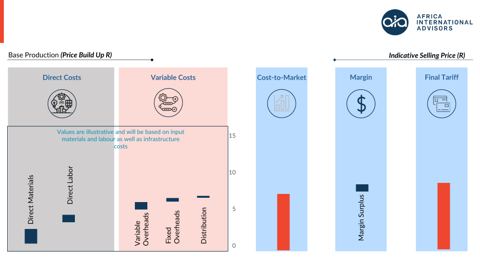
AIA's cost-build-up approach to financial modelling and tariff/pricing determination, disaggregating cost drivers (direct materials, labour, overheads, regulatory/compliance, logistics, margin) and applying a micro-macro sensitivity analysis before recommending a tariff or price.
What it is
A cost-build-up financial model that layers direct costs, overheads, regulatory/compliance costs, logistics and margin into a recommended tariff or price, validated through a micro (internal) / macro (external) sensitivity analysis of exchange rate, inflation, volume and process-efficiency variables.
Problem it solves
Clients need a transparent, defensible tariff or price that reflects true cost-to-serve and can withstand scrutiny from regulators, funders or customers, and that is stress-tested against macro volatility.
When to use
- Tariff-setting for a regulated or quasi-regulated service
- Energy/commodity netback pricing (e.g. LNG, gas)
- Any engagement requiring a defensible cost-to-market build-up
Key questions
- What is the base cost (direct materials + labour + overheads)?
- What regulatory/compliance costs apply?
- What logistics and administrative costs apply to reach the point of sale?
- What margin is required, and how sensitive is the final tariff to exchange rate, inflation and volume changes?
Inputs
- Direct material and labour cost data
- Overhead and compliance cost data
- Logistics and distribution cost data
- Exchange-rate and inflation assumptions
Steps
- 1Base costSum direct materials, direct labour, variable overheads and fixed overheads.
- 2Regulatory & compliance layerAdd certification/standards costs and government levies to the base cost.
- 3Distribution & administrative add-onAdd logistics, warehousing and billing/admin overheads to reach cost to point-of-sale.
- 4Market/margin componentAdd margin to cost-to-point-of-sale to determine the final tariff.
- 5Micro-macro sensitivity analysisTest the tariff against exchange-rate movement, inflation/cost escalation, volume/throughput changes and process-efficiency gains.
Outputs
- Recommended tariff/price with cost build-up
- Sensitivity analysis and trigger points for tariff adjustment
Source visuals