Market Sizing (Top-Down / Bottom-Up Triangulation)
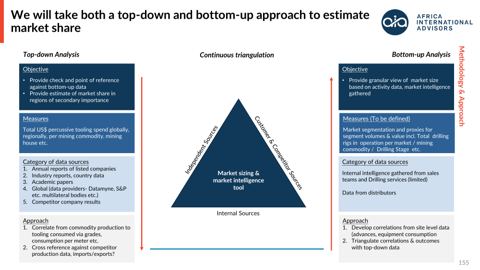
AIA's repeated approach to sizing markets by independently building a top-down estimate (macro data, industry reports, competitor results) and a bottom-up estimate (internal/site-level intelligence), then triangulating and validating both against a third, independent data source.
What it is
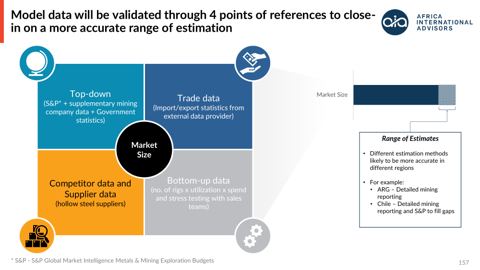
A market-sizing technique that produces two independent estimates of market size or share — a top-down estimate from macro/industry/competitor data and a bottom-up estimate from internal, distributor or site-level data — and reconciles them through continuous triangulation, validated further where possible against a third or fourth independent reference point (e.g. trade data, supplier data).
Problem it solves
A single data source for market size is rarely reliable; triangulating top-down and bottom-up estimates (and a third check) produces a defensible range rather than a false-precision point estimate.
When to use
- A client needs a defensible market size or market-share estimate
- Reliable single-source market data does not exist for the sector/geography
When not to use
- Robust, audited market data is already available from a single trusted source
Key questions
- What does the top-down (macro/industry/competitor) estimate show?
- What does the bottom-up (internal/site-level) estimate show?
- Where do the two estimates diverge, and what does a third data source suggest is correct?
Inputs
- Industry reports, annual reports of listed companies, government/trade statistics (top-down)
- Internal sales, distributor or site-level activity data (bottom-up)
- Trade, supplier or competitor data (validation layer)
Steps
- 1Top-down analysisEstimate market size from macro, industry and competitor data sources, providing a check and point of reference.
- 2Bottom-up analysisEstimate market size from internal, distributor or site-level activity data, providing a granular view.
- 3Continuous triangulationCompare and reconcile the two estimates on an ongoing basis rather than as a one-off check.
- 4Independent validationCross-check against a third/fourth independent data source (e.g. trade data, competitor/supplier data) to close in on a validated range.
Outputs
- Validated market-size / market-share estimate with a defensible range
- Segmented market model (by region, country, commodity, competitor, etc.)
Source visuals