Business Process Re-engineeringStandard Methodology
SIPOC Framework
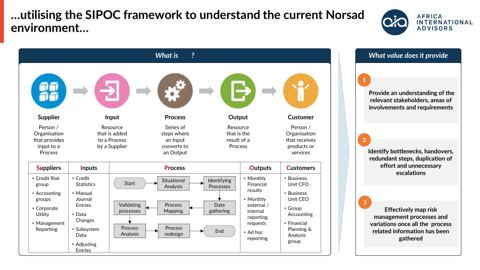
AIA's application of the standard Suppliers-Inputs-Process-Outputs-Customers framework to understand a process environment before analysis, mapping and redesign.
What it is
A structured process-scoping tool that identifies Suppliers (who provides input), Inputs (what is added to the process), the Process itself (the steps converting input to output), Outputs (what the process produces) and Customers (who receives it) — used as a first step before deeper process mapping and analysis.
Problem it solves
Ensures a process improvement effort starts from a shared, validated understanding of the process boundaries and stakeholders, rather than jumping straight to redesign.
When to use
- At the start of a process re-engineering or DMAIC effort, to establish situational understanding before deeper analysis
Key questions
- Who supplies input to this process?
- What inputs and outputs does the process involve?
- Who are the customers of this process, and what do they require?
Inputs
- Stakeholder interviews
- Existing process documentation (if any)
Steps
- 1Situational analysis & process identificationIdentify the processes in scope and the relevant stakeholders, areas of involvement and requirements.
- 2Data gathering & process mappingMap suppliers, inputs, process steps, outputs and customers.
- 3ValidateValidate the mapped process with stakeholders, identifying bottlenecks, hand-offs, redundant steps and unnecessary escalations.
- 4Process analysisAnalyse the validated map to inform redesign (see Process Re-engineering / 7R Framework).
Outputs
- Validated SIPOC map
- List of bottlenecks, hand-offs, duplication and unnecessary escalations
Source visuals
SIPOCprocess mappingsituational analysis
Related methodologies
Custodian: Corporate Support. Internal (staff access). Source: AIA_Methodologies_2024.pptx (slides 110).