Work Study (OEE / TEEP Productivity Analysis)
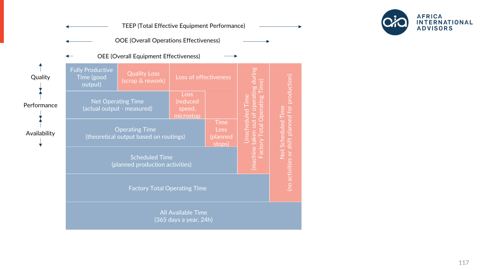
AIA's work-study technique for measuring productive time and effectiveness, adapting the manufacturing Overall Equipment Effectiveness (OEE) / Total Effective Equipment Performance (TEEP) model to operational contexts such as port efficiency.
What it is
A time- and effectiveness-loss decomposition (Quality, Performance, Availability) that breaks total available time down into scheduled/unscheduled, operating and net-operating time, separating out quality loss, speed loss and time loss to quantify Overall Equipment/Operations Effectiveness (OEE/OOE) and Total Effective Equipment/Port Performance (TEEP/TEPP).
Problem it solves
Gives a defensible, quantified answer to 'how much productive time are we actually losing, and to what' — rather than an anecdotal sense that operations are inefficient.
When to use
- An operational efficiency diagnostic requires quantified loss decomposition (e.g. port, plant or production efficiency)
Key questions
- What is fully productive time versus time lost to quality, speed or scheduling issues?
- What is the Overall Effectiveness (OEE/OOE) and Total Effective Performance (TEEP/TEPP)?
Inputs
- Operational time and output data (scheduled/unscheduled time, throughput, quality/rework data)
Steps
- 1Establish all available timeStart from total calendar time available (365 days x 24h).
- 2Deduct not-scheduled and unscheduled timeSeparate out time with no planned activity and time lost to unplanned stoppages.
- 3Decompose operating timeSeparate speed loss, time loss and quality loss from net operating/fully productive time.
- 4Calculate effectiveness ratiosCompute Availability x Performance x Quality to derive OEE/OOE, and TEEP/TEPP against all available time.
Outputs
- Quantified productivity/effectiveness loss breakdown
- OEE/TEEP or port-specific equivalent (TEPP) metrics
Source visuals