Corporate Strategy Development
AIA's approach to developing corporate strategy, cascading from corporate intent through business-unit and functional strategy, using a small family of structuring tools (Play to Win choice cascade, Strategy Building Blocks, Strategy-on-a-Page) to converge stakeholders on a single answer.
What it is
A structured sequence for developing corporate strategy that starts at the corporate level and cascades to business-unit and functional strategies, using recognised choice-cascade tools (adapted from Play to Win / Bain-style frameworks) to force clarity on aspiration, where to play, how to win, required capabilities and management systems.
Problem it solves
Organisations often have activity plans but no strategy: a genuine, sequenced set of choices about where to compete and how to win that is understood consistently from the boardroom to the front line.
When to use
- A new corporate strategy or strategy refresh is required
- Business-unit strategies need to be aligned to a corporate direction
- Leadership needs a single, one-page articulation of strategy for cascading and communication
When not to use
- The task is narrow operational planning rather than strategic choice-making
- There is no executive mandate or sponsorship to make and hold strategic choices
Key questions
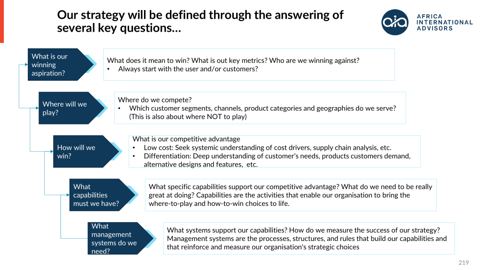
- What is our winning aspiration?
- Where will we play?
- How will we win?
- What capabilities must we have?
- What management systems do we need?
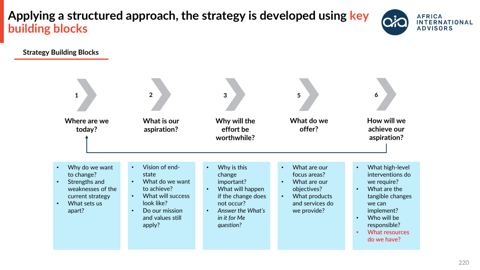
- Why do we want to change?
- What is our aspiration and what will success look like?
Inputs
- Corporate mandate, vision and mission
- Market and competitor context
- Internal capability and resource assessment
- Executive and board sponsorship
Steps
- 1Define the strategic questionClarify why change is needed and what winning looks like at corporate level.
- 2Corporate strategySet corporate-level direction and portfolio choices first.
- 3Business unit strategyCascade corporate direction into business-unit strategies aligned to the corporate intent.
- 4Functional strategyTranslate business-unit strategy into functional plans (finance, operations, people, technology).
- 5Apply the choice cascadeUse Play to Win-style questions (winning aspiration, where to play, how to win, capabilities, management systems) to pressure-test the strategy.
- 6Summarise on a pageCondense vision, mission, strategic goals, objectives, performance metrics and initiatives into a single Strategy-on-a-Page artefact for cascading.
Outputs
- Corporate strategy document
- Business-unit and functional strategy alignment
- Strategy-on-a-Page communication artefact
- Prioritised strategic initiatives
Common mistakes
- Treating an activity list as a strategy without making explicit where-to-play/how-to-win choices
- Skipping the cascade from corporate to business-unit to functional strategy, leaving misalignment
- Producing a strategy document with no one-page version leaders can actually cascade
How to tailor
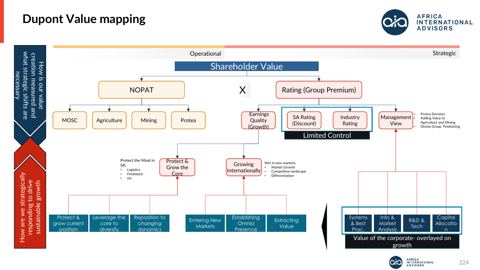
The choice-cascade questions and Strategy-on-a-Page structure are reusable; the specific frameworks used to answer them (Dupont value mapping, market attractiveness/right-to-win matrices) should be selected based on sector and data availability.
Source visuals