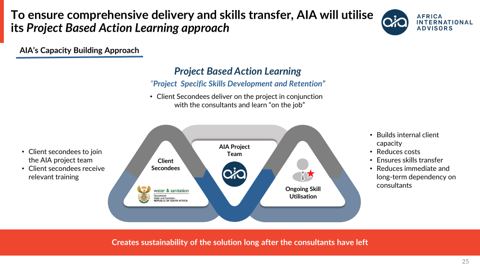
Project Based Action Learning
AIA's capacity-building delivery model: client secondees join the AIA project team and learn on the job alongside consultants, building internal capacity, reducing cost and reducing long-term dependency on consultants. Independently evidenced by Project Khaedu, a large-scale public-sector Action Learning training programme referenced on the AIA website.
What it is
A capacity-building approach in which client staff ('secondees') are embedded in the AIA project team, receive relevant training and deliver the project 'on the job' alongside consultants — creating sustainability of the solution after the consultants leave, and reducing both cost and long-term dependency.
Problem it solves
Traditional consulting delivery can leave clients dependent on the consultant after the engagement ends; Project Based Action Learning builds internal capability during delivery itself.
When to use
- Client sustainability and internal capacity-building are explicit objectives of the engagement
- Long engagements where ongoing client capability is more valuable than a one-off deliverable
Key questions
- Which client staff can be seconded into the project team?
- What training do secondees need to contribute meaningfully?
- How will skills and tools remain with the client after the engagement ends?
Inputs
- Client secondees with relevant institutional knowledge
- AIA project team and delivery plan
Steps
- 1Second client staffClient secondees join the AIA project team.
- 2Train secondeesSecondees receive project-specific skills training relevant to their role on the engagement.
- 3Deliver togetherSecondees and consultants deliver the project jointly, transferring skills 'on the job'.
- 4Sustain capabilitySecondees continue using the skills and tools after the AIA project team has left, reducing long-term dependency.
Outputs
- Capacitated client staff
- Reduced long-term consulting dependency
- Sustained solution post-engagement
Source visuals