Change & Culture Management
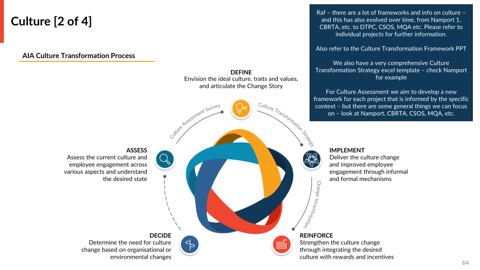
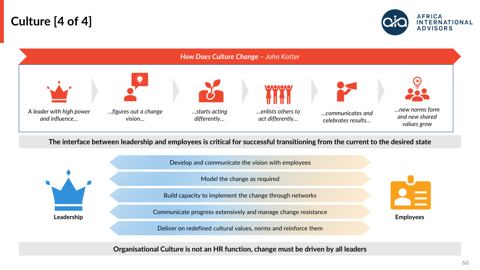
AIA's five-stage culture transformation process (Define, Assess, Decide, Implement, Reinforce), aligned to a Prepare-Manage-Reinforce change-management cadence and Kotter's model of how culture actually changes, always redeveloped per project context.
What it is
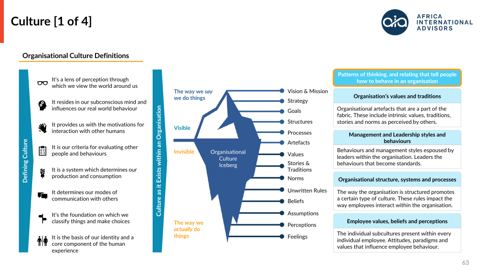
A culture-change methodology visualising organisational culture as an iceberg (visible strategy/structure/processes above the waterline; invisible values, beliefs, assumptions and unwritten rules below), moved through five stages — Define, Assess, Decide, Implement, Reinforce — aligned to a Prepare-for-Change / Manage-Change / Reinforce-Change cadence, and informed by Kotter's model of how culture changes (vision, role-modelling, network-building, communication, reinforcement).
Problem it solves
Culture change efforts fail when they target only visible artefacts (structures, policies) without addressing the invisible layer (values, beliefs, unwritten rules) or without genuine leadership behaviour change.
When to use
- An organisation needs a structured culture transformation programme, not just a communications campaign
- Leadership behaviour change is a stated objective alongside structural/process change
When not to use
- The organisation has not secured senior leadership sponsorship — culture change here is explicitly framed as a leadership-owned, not HR-owned, function
Key questions
- What is the current culture, above and below the waterline?
- What culture change is needed to support the strategy?
- Is leadership visibly modelling the new culture, not just communicating it?
Inputs
- Culture assessment survey results
- Leadership commitment and change sponsorship
- Employee focus group input
Steps
- 1DefineEnvision the ideal culture, traits and values, and articulate the change story.
- 2AssessAssess current culture and employee engagement, and understand the desired state (see Culture Survey).
- 3DecideDetermine the need for culture change based on organisational or environmental change.
- 4ImplementDeliver the culture change and improved engagement through informal and formal mechanisms; prepare for change by building awareness and desire, then manage change by communicating and building capacity.
- 5ReinforceStrengthen the culture change by integrating the desired culture with rewards and incentives, sustained through mechanisms that embed new norms.
Outputs
- Culture transformation strategy
- Change incentivisation plan
- Leadership behaviour commitments
How to tailor
The five-stage process and iceberg model are reusable; per AIA's own guidance in the source deck, a new detailed assessment framework should be developed for each project based on its specific context (see prior projects: Namport, CBRTA, CSOS, MQA).
Source visuals